

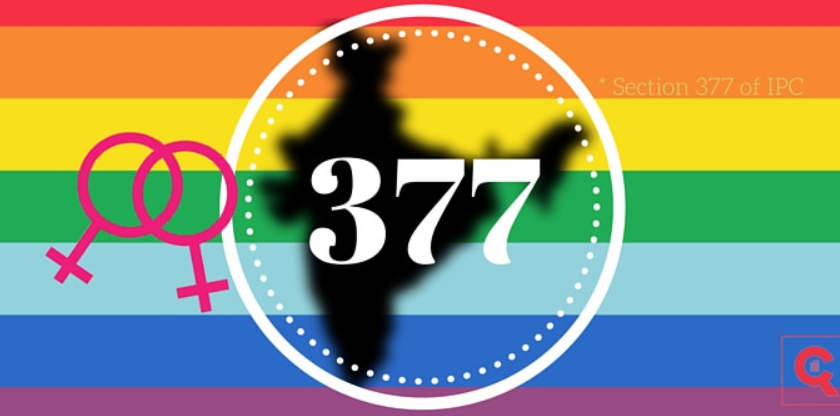
Will the striking down of section 377 the Supreme Court alone ensure the dignity to LGBTQ community in India when inter-caste marriages are still a taboo?
A few weeks ago, the Supreme Court of India in its historic judgement partially struck down the section 377 of Indian Penal Code, decriminalizing the homosexuality. On the television and social media, except a few groups, entire nation seemed to be celebrating such a watershed moment and the victory of LGBTQ community and its heterosexual allies that had been fighting for some of the fundamental rights enshrined in the constitution which the people belonging to LGBTQ community had been deprived of under the 157 years old archaic colonial law.
Overturning its own 2013 judgement on the homosexuality, Supreme Court of India finally reasserted the tenets of India being a liberal democracy, where the constitution values such as equality and liberty are the major driving forces that keep a country as diverse as India intact and united. It also reinforced the fact that the majoritarian views and popular opinions can’t dictate the constitutional rights in a democracy as the majority opinion is not always the right opinion.
But given the ironical times we live in, a few questions genuinely need to be pondered over in the wake of this recent decriminalization of homosexuality, which I believe many of you must have already come across in the various social networking sites.
The questions are: Will the Indian society accept the homosexuality as a natural and common phenomenon when the inter-caste marriages are still not allowed in the most of the parts of the country, especially in rural areas where doing so can not only lead to the excommunication of the pertaining families but also can put the lives of couple in peril, at times? How long will it take for the Indian society to internalize and come to terms with the fact that homosexuality is not a disease, and homosexuals are as much of humans as us, hence they have as much of rights as we have in every sphere of life?
The aversion towards inter-caste marriages has been in existence for centuries despite the fact that no rule in any of the Indian statue books illegalize the inter-caste marriage or discourage the people to do so. But this is the very harsh reality that no matter how modern and liberal we may claim to have become as a society, such customs continue to persist not only amongst the uneducated families but even in many highly educated and well-off families. In some cases, it is the social stigma attached to it and the fear of being outcasted and ostracized that prevent the families to come out of the social chains, while in other cases it’s their own staunch self-belief in the superiority of their caste which, they believe, may get impure if somebody from their family marries a person from lower caste.
As far as the question of the time period homosexuality will take to be normalized in India is concerned, the answer remains precarious—given the various instances of social unacceptance and the stigmas attached to many social practices that are not in popular parlance despite their legality.
This leads us to the conclusion that in order to normalize any practice, which has so far been abhorred the majority of the people due to their own pre-conceived notions and prejudices against it, only protection the law is not sufficient. It’s more about the mindset and the general attitude of the people living in the society that needs to be inclusive and adaptive enough to accept homosexuality as one’s sexual orientation rather than an anomaly or aberration. The day heterosexuals stop distancing themselves from befriending with the homosexuals because of the latter’s sexuality, and the barrage of jokes and memes made upon homosexuals come to halt, that will be the day when we as a society would be successful in bringing an isolated section of the society into the mainstream.

Currently, I am pursuing B.A(H) Political science from Satyawati College, Delhi University.
I like public speaking, writing and reading in my leisure.


